
The modern information age relies on highly crystalline semiconductors produced through energy-intensive, top-down fabrication with high material costs. Colloidal quantum dots (CQDs) herald the transition to a bottom-up design, retaining the crystalline nature of semiconductors and offering a striking playground for mesoscale technologies by solution-processing. The surface-dominated characteristics of CQD require radical new concepts and methodologies in functional design and solution processing. Through the utilization of ionic surface decoration, semiconductive CQDs with tailored composition, size, and electronic structure can be effectively dispersed into polar solvents, forming conductive inks as an emerging fabrication technique for next-generation CQD electronics by printing.
However, the transfer of these emerging CQD inks into the industry is currently hindered by the lack of scalable and cost-effective inks, placing stringent requisites on ink stability and simplified processing. The ink stability is not only decisive for industrial mass production but also governs nano-morphology and microstructure formation in the CQD assembly.The ideal CQD semiconductor for high-performance electronics is characterized by fast charge transport at minimum energy losses. This requires a fine-tuned surface matrix with nanoscale morphology control and macroscopic film uniformity.Unstable CQD inks result in films that (i) suffer from morphological inhomogeneity, including serious aggregation and even inter-CQD epitaxial fusion, and (ii) show significant energetic disorder and electro-optically active traps. Both facts have been inhibiting the printing and scaling-up of efficient CQD electronics, which has been particularly expressed in the field of CQD photovoltaics.
Strategies have been developed in recent years to address the issues raised by ink instability, including surface chemistry engineering by introducing solvophilic surface ligands and facet-specific surface passivation, as well as solvent selection,some of which have been successfully applied to the printed photovoltaic devices. However, the printing of CQD solar cells is still restricted to lab-scale small-area devices, and, presently, the power conversion efficiencies (PCEs) significantly lag behind those of spin-coated cells. This makes the successful demonstration of efficient CQD modules more challenging. The highest reported PCE of a CQD module with an active area larger than 10 cm2 is only around 1%, in contrast to the certified efficiency of over 12% for small-scale devices, which is significantly below the level needed for the commercialization interest of CQD photovoltaics.Moreover, the complex preparations of CQD inks based on the hot injection and ligand exchange method induce material costs as high as 0.25-0.84 $/Wp for the CQD active layers, limiting the cost-effective mass production.Thus, it remains an urgent challenge to explore innovative concepts and strategies towards efficient, scalable, and low-cost CQD electronics made from conductive CQD inks. Realizing well-stabilized CQD inks with a minimum amount of stabilizer is necessary for efficient and scalable CQD electronics. This requires an in-depth understanding of the solution chemistry during the preparation of CQD inks.
To address these challenges, Professors Wanli Ma and Zeke Liu from the Institute of Functional Nano & Soft Materials (FUNSOM) at Soochow University, collaborating with international teams, proposed an ink stabilization strategy, employing solution chemistry engineering (SCE) to functionalize the surface of PbS CQD in the cost-effective direct-synthesis (DS) inks through precise control of adsorbed ions. This strategy allows the development of stable inks with the “anti-fusion” feature, bringing about high-performance, large-area, and low-cost CQD photovoltaics by scalable printing. By employing the weakly coordinating solvents in combination under an I-rich environment, the iodoplumbates could be effectively converted into functional anionic complexes, which condensed into a robust surface shell and suppress irreversible inter-dot epitaxial fusion. This, in turn, yields stable ink that is suitable for scalable printing of CQD film with three-dimensional (3D) uniformity. A breakthrough in CQD photovoltaic performance is achieved with a certified PCE of 13.40% for the lab-scale cells. Moreover, the scalable printing of the first CQD solar module with PCE exceeding 10% is successfully demonstrated with a low active material cost of 0.06 $/Wp and a significantly reduced environmental impact. The findings have been published in Nature Energy (DOI: 10.1038/s41560-025-01746-4). The co-first author are Dr. Guozheng Shi and PhD student Xiaobo Ding from FUNSOM at Soochow University.
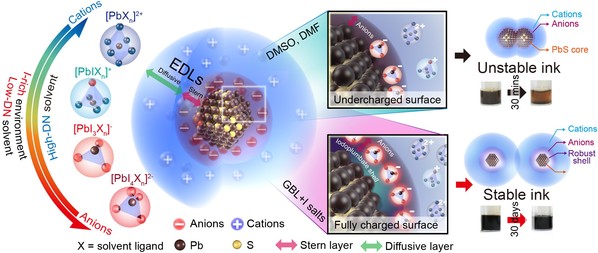
Fig. Solution chemistry engineering (SCE) enables stable CQD inks
Link to paper:https://www.nature.com/articles/s41560-025-01746-4
Title:Overcoming efficiency and cost barriers for large-area quantum dot photovoltaics through stable ink engineering
Authors:Guozheng Shi,Xiaobo Ding,Zeke Liu,* Yang Liu,Yifan Chen, Cheng Liu,Zitao Ni, Haibin Wang, Katsuji Ito, Keisuke Igarashi,Kun Feng,Kaicheng Zhang, Larry Lüer,Wei Chen,Xingyi Lyu,Bin Song, Xiang Sun, Lin Yuan, Dong Liu,Yusheng Li, Kunyuan Lu,Wei Deng,Youyong Li, Peter Müller-Buschbaum, Tao Li, Jun Zhong,Satoshi Uchida, Takaya Kubo,Ning Li,Joseph M. Luther,Hiroshi Segawa, * Qing Shen,* Christoph J. Brabec,and Wanli Ma*
Link to research briefing:https://www.nature.com/articles/s41560-025-01747-3
Editor: Guo Jia