
Recently, research teams led by Professors Liang-Sheng Liao and Ya-Kun Wang from the Institute of Functional Nano & Soft Materials at Soochow University, in collaboration with Professor Wenming Su’s team from the Suzhou Institute of Nano-Tech and Nano-Bionics, Chinese Academy of Sciences, have made a significant breakthrough in a core area of next-generation high-end display technologies. The team proposed a “dipole-assisted surface ordering” strategy and successfully developed lead-free and cadmium-free deep-blue quantum dot light-emitting devices that simultaneously achieve high efficiency, high brightness, and long operational lifetime. This work lays a solid foundation for environmentally friendly, high-end display technologies. The results were published online on March 19, 2026, in the top-tier international journal Nature Photonics.
Breaking the Deep-Blue Bottleneck: Solving the “Impossible Triangle” in Eco-Friendly Displays
Quantum dot display technology is a key strategic emerging industry worldwide. Among its core components, deep-blue emission—one of the primary colors for full-color displays—has long faced a global challenge: it is extremely difficult to simultaneously achieve high efficiency, high brightness, and high stability. Meanwhile, in response to the global push for green and sustainable development, the development of environmentally friendly quantum dot materials free of heavy metals (such as lead and cadmium) has become a major competitive frontier in this field.
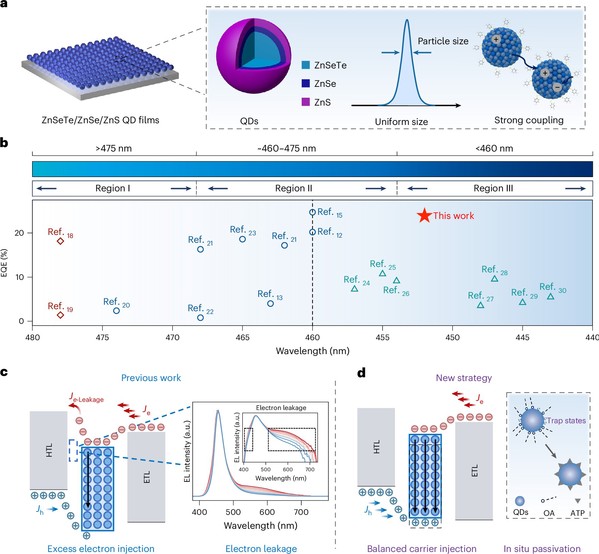
Through close collaboration, the teams led by Liang-Sheng Liao and Ya-Kun Wang at Soochow University and Wenming Su at the Suzhou Institute of Nano-Tech and Nano-Bionics adopted an innovative approach. They proposed a new strategy based on functional molecule regulation. By introducing specific functional molecules into ZnTeSe (zinc telluride selenide) quantum dots, the team achieved long-range ordered arrangement of quantum dot films. This significantly enhanced the photoluminescence quantum efficiency of the films, optimized their energy level structure, and greatly reduced the hole injection barrier. This approach simultaneously addresses carrier transport and surface defect issues at the material level, providing a new pathway to overcome performance bottlenecks in eco-friendly deep-blue devices.
Deep-blue quantum dot light-emitting diodes (QLEDs) constructed using this strategy exhibit an external quantum efficiency as high as 23.6%, setting a new record for heavy-metal-free deep-blue quantum dot devices. The devices also achieve a peak brightness of 12,000 cd/m² and demonstrate a half-lifetime (T50) exceeding 50,000 hours (over six years) at an initial brightness of 100 cd/m². This represents a synergistic breakthrough in both efficiency and stability within a lead-free and cadmium-free system, marking a critical step toward the practical application of environmentally friendly quantum dot devices.
Dr. Wanshan Shen (Soochow University), Dr. Liming Xie (Suzhou Institute of Nano-Tech and Nano-Bionics, CAS), and graduate students Wen-Long Fei and Xin Gu (Soochow University) are the co-first authors of the paper. This work was strongly supported by the Institute of Functional Nano & Soft Materials at Soochow University, the State Key Laboratory of Bionic Interface Materials Science, the Suzhou Institute of Nano-Tech and Nano-Bionics (CAS), and Suzhou Xingshuo Nanotechnology Co., Ltd. Financial support was provided by the National Natural Science Foundation of China (Young Scientists Fund B and General Program) and the National Key R&D Program (Nanotechnology Special Project).
Link:https://www.nature.com/articles/s41566-026-01878-3
Title:Dipole-assisted functionalization enables long-range ordering of ZnTeSe quantum dots for efficient and stable deep-blue electroluminescence
Author information:Wan-Shan Shen#, Li-Ming Xie#, Wen-Long Fei#, Xin Gu#, Ye Wang, Hua-Hui Li, Wei-Zhi Liu, Yun-Jun Wang, Wen-Ming Su*, Ya-Kun Wang* & Liang-Sheng Liao*
Editor: Guo Jia