
Atmospheric thermal energy is the most abundant all-weather low-grade energy source on Earth, with a total magnitude three orders of magnitude greater than global energy consumption. Evaporation-driven power generation (EPG) converts this energy into electricity via the streaming potential effect, offering a promising route for continuous ambient energy harvesting. However, conventional thin-film and bulk device architectures suffer from disordered, sluggish fluid flow and severe ion scattering, causing most absorbed thermal energy to dissipate as waste heat. The long-standing limitations in power density (PD) and energy conversion efficiency have hindered practical application of this technology.
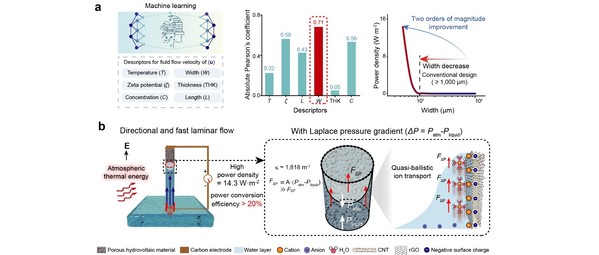
Recently, Prof. Lin Jiang’s research group from FUNSOM, Soochow University made a major breakthrough. Their work, published in Nature Energy, introduces a machine learning-guided vertical microrod generator (VMG). A dataset of 585 data points was compiled, and after evaluating eight ML algorithms, the XGB model achieved the highest predictive accuracy. Pearson analysis identified device width as the dominant factor (|r| = 0.71), with an optimal width of 550 μm. The VMG design enables quasi-ballistic ion transport through synergistic macroscopic and nanoscale effects: the high-curvature cylindrical surface generates a directional Laplace pressure gradient that aligns ion migration with the intrinsic electric field, while nanoconfinement (pore size 0.67–0.93 nm matching the Bjerrum length ~0.8 nm) combined with the Donnan effect enables low-scattering Na⁺ transport.
The VMG delivers a PCE of 21.5% and a PD of 14.3 W·m-2 under ambient conditions, a two-orders-of-magnitude improvement over conventional devices, with PCE remaining above 20% across a 30 K temperature span. The device operates stably for over 30 days with carbon electrodes. Modular integration via series-parallel arrays drives commercial electronics including emergency lights, 36 W ceiling lamps, smoke alarms and 96 W LED displays. This work provides both a feasible fabrication strategy and a theoretical foundation for efficient low-grade thermal energy harvesting and next-generation ambient energy devices.
Link to paper:https://www.nature.com/articles/s41560-026-02117-3
Title: Quasi-ballistic ion transport in a vertical microrod enabling efficient evaporation-driven power generation
Authors: Miao Wu, Tianyi Wang, Junchang Zhang, Rui Zhang, Bo Zhao, Zekun Wang, Chuan Shan, Sifan Zhang, Kangxin He, Zhiqiang Liang, Meiwen Peng*, Yinghui Sun*& Lin Jiang*
Link to Prof. Lin Jiang’s group: http://www.funsom.com/
Editor: Guo Jia